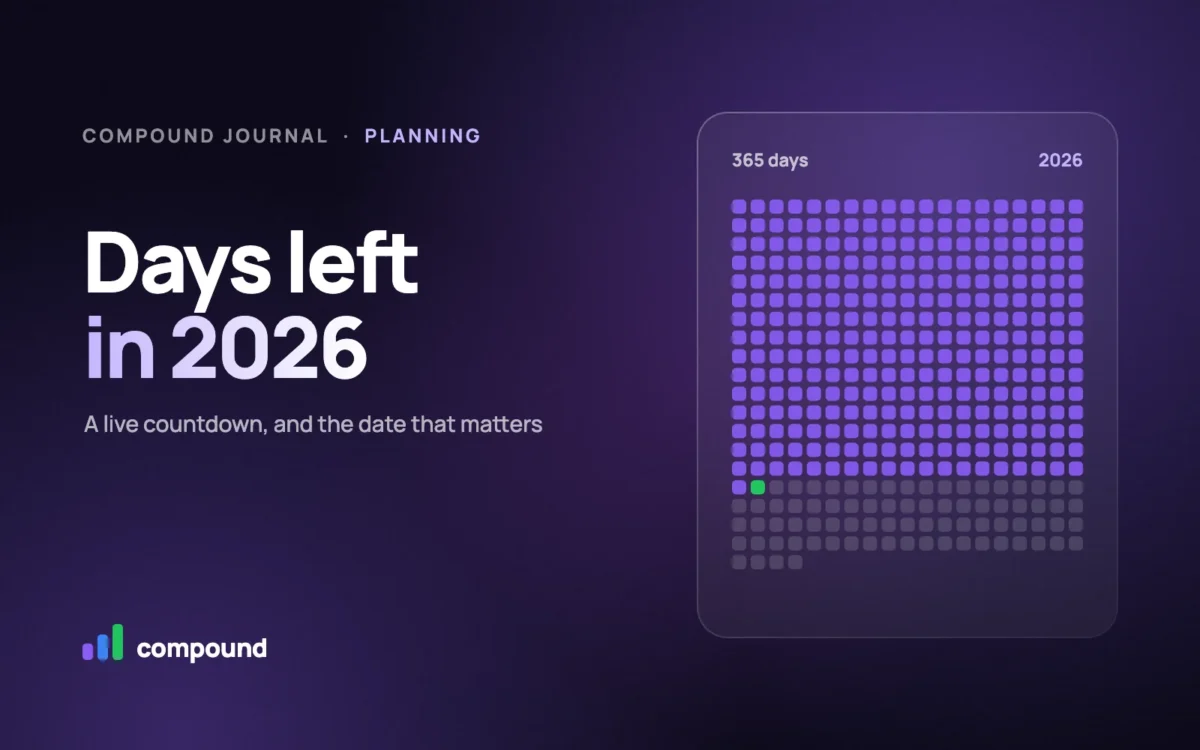
The final quarter of the year runs from 1 October to 31 December: 92 days, a little over 13 weeks. It’s the stretch where most annual goals die quietly, and the stretch where a focused person can still change how the whole year reads.
This guide gives you a system for it. It takes about an hour to set up and five minutes a day to run.
Why the last 90 days are different
Two forces work against you in Q4.
The “next year” reflex. Once autumn arrives, it becomes very easy to postpone anything hard to January. Psychologists call the pull of new beginnings the fresh start effect: people are more likely to start goals after temporal landmarks like a new year, a birthday or a Monday. It’s useful in January. In October it works against you, because every postponed goal gets parked behind the biggest landmark of all.
The December cliff. Holidays, travel, year-end deadlines and social plans eat the last two weeks. On paper you have 92 days. In practice you have closer to 75.
The plan below is built around both. It gives you a reason to act now and assumes December will be messy.
Step 1: Count what you actually have (10 minutes)
Open the live countdown of days left in the year and write down three numbers:
- Days left. The raw number.
- Usable days. Subtract the days you already know are gone: trips, events, the last two weeks of December. Be pessimistic.
- Weeks left. Usable days divided by seven, rounded down.
That third number is your budget. Everything else in this plan is spent from it.
Step 2: Pick three outcomes, not ten (15 minutes)
List everything you wanted from this year. Then cut it to three outcomes that meet two tests:
- It would change how you remember 2026. Not “nice to have”. The question is: if this happens, does the year feel won?
- It can be finished, or clearly advanced, in your weeks budget. “Write a book” fails. “Finish the first draft of chapters 1–5” passes.
Write each one as a finished sentence in the past tense, dated 31 December:
By 31 December, I had shipped the website, run 3 times a week, and saved the deposit.
Three is not arbitrary. Each outcome will become one or two daily habits, and most people can sustain three to five new habits at once before the system collapses.
Step 3: Turn each outcome into a daily habit (15 minutes)
Goals describe where you want to be. Habits are what you do on an ordinary Tuesday. For each outcome, ask:
“What would I have to do almost every day for this to be inevitable?”
| Outcome by 31 December | Daily or weekly habit | Minimum version for bad days |
|---|---|---|
| Ship the website | 45 minutes of focused work on it, Monday to Friday | Open the file and fix one thing |
| Run 3× a week | Run on Monday, Wednesday, Saturday | Put the shoes on and walk 10 minutes |
| Save the deposit | Move money on payday; log spending daily | Log one day’s spending |
The third column matters most. Research on habit formation suggests that missing one day doesn’t break a habit, but missing several in a row does. The minimum version is how you never miss twice. Read more in How long does it take to build a habit?
Make each habit specific with an if–then plan: “If it’s 7:00 on a weekday, then I open the website project before email.” Studies on these implementation intentions consistently find they raise follow-through compared with good intentions alone.
Step 4: Run the quarter as 13 one-week sprints
Don’t plan October, November and December. Plan this week.
Every Sunday, spend 15 minutes on three questions:
- What did I tick last week? Count completions per habit. No commentary yet, just numbers.
- What got in the way? One sentence per habit that slipped.
- What’s this week’s version of each outcome? One concrete deliverable per outcome.
Thirteen weeks gives you thirteen chances to correct course. A monthly review gives you three.
Step 5: Protect December before it starts
Plan as if the year ends on 18 December. Front-load the hard work into October and November, and treat the last two weeks as buffer.
Two things to decide now:
- Which habits pause, and which shrink? Travel days can switch every habit to its minimum version. Pausing on purpose is not the same as breaking a streak.
- When is your year-in-review? Block an hour between Christmas and New Year to look back on the 12 months, using our one-hour year-in-review ritual. It’s the bridge from this plan to next year’s.
Step 6: Track it where you’ll see it daily
A plan you can’t see is a plan you’ll forget. Whatever tool you use, it needs to show three things at a glance: today’s habits, your completion record, and the days left.
That’s the reason Compound — Habit Tracker puts a live year countdown next to your daily habits. Every tick sits against the time actually left. It runs on Mac, Windows, iPhone and Android from one licence, paid once ($19 during Black Friday, then $39).
Prefer paper? Our free printable habit tracker for 2027 works for this quarter too. Use the October to December pages of your choice by writing in the dates.
The 90-day plan on one page
- Count days left, usable days and weeks left.
- Pick three outcomes and write them in the past tense, dated 31 December.
- Turn each into a daily habit with a minimum version.
- Review every Sunday: completions, obstacles, this week’s deliverable.
- Plan as if the year ends on 18 December.
- Track daily, in one place, with the countdown in view.
FAQ
When do the last 90 days of the year start?
Counting 31 December as the last day, the final 90 days of a non-leap year start on 3 October. The final quarter, Q4, starts on 1 October and has 92 days.
How many goals should I set for the last quarter?
Three at most. Each goal usually needs one or two daily habits to happen, and most people can’t sustain more than three to five new habits at once.
Is it too late to start a goal in November?
No. A habit started in November keeps building into January, so you start the new year already in motion. Use the days-left countdown to size a goal to the weeks you really have.
What’s the difference between a goal and a habit?
A goal is a result you want by a date. A habit is a repeated action that makes the result likely. In this plan, every goal is translated into one or two habits you can tick each day.