“Don’t break the chain” is one of the most repeated pieces of productivity advice, and for good reason. Streaks work. But they also fail in a predictable way: the day you break one, the whole habit can collapse with it. Understanding why streaks work makes it easier to keep the benefit and drop the trap.
Why streaks are so effective
A streak turns an invisible process into something you can see. Building a habit is slow and mostly unrewarding at first; the payoff arrives months later. A growing number gives you a reward today. Each tick says “you’re the kind of person who does this”, which is the identity shift most habits need.
Streaks also tap into loss aversion. People feel the pain of losing something more strongly than the pleasure of gaining the same thing. Once you have a 30-day streak, protecting it becomes a motivation in its own right. On the days you don’t feel like it, “I don’t want to lose 30 days” can be enough.
The trap: the what-the-hell effect
Researchers studying dieting described a pattern often called the “what-the-hell effect”: after breaking a rule once, people tend to abandon it entirely for the rest of the day. “I already had the cake, so I might as well have three.” Streaks invite the same reaction. When the counter drops from 47 to 0, the habit suddenly feels worthless, and quitting feels logical.
The counter going to zero is a display problem, not a progress problem. Forty-seven days of practice don’t disappear because of one missed day.
What the research says about one missed day
In the well-known University College London study on habit formation, missing a single day did not meaningfully affect how automatic a behaviour became. Habits are built by repetition over weeks and months, and one gap in the repetitions barely registers. What does damage a habit is a run of misses, long enough that the cue stops triggering the behaviour.
The rule that keeps a miss from becoming a slide
Never miss twice. That’s the whole rule. One missed day is life happening. Two in a row is the beginning of a different habit. When you miss, your only job tomorrow is the smallest possible version of the habit. Not a make-up session, not double the effort: just the minimum, to restart the chain.
Track the rate, not just the streak
A completion rate is more forgiving and more honest than a streak alone. Twenty-seven days out of thirty is 90%, an excellent month, even if the current streak is three. Seeing both numbers side by side keeps the motivation of the streak without letting one bad day define the month.
- Current streak: your short-term motivation.
- Best streak: proof of what you can do.
- Monthly completion: the real measure of the habit.
When you break a long streak
Write down why it broke, in one line. Travel? Illness? A habit that’s too big? Then restart the next day with the minimum version. Many people find their second streak lasts longer than the first, because they’ve learned exactly where the habit is fragile.
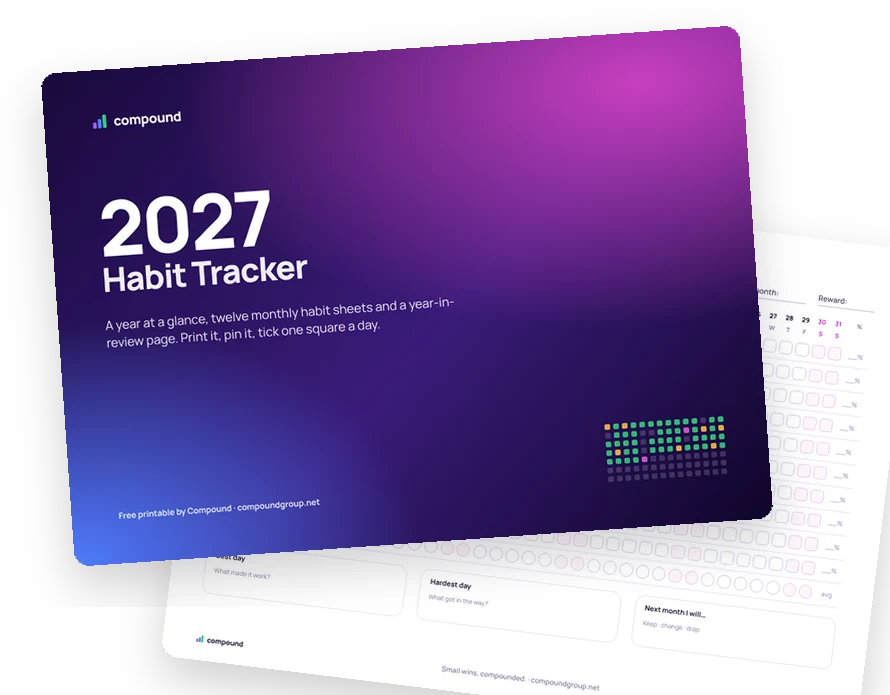
In Compound, every habit shows its current streak, your best streaks are highlighted, and the monthly grid shows completion in percent. A missed square is just one square in a month that’s mostly full.