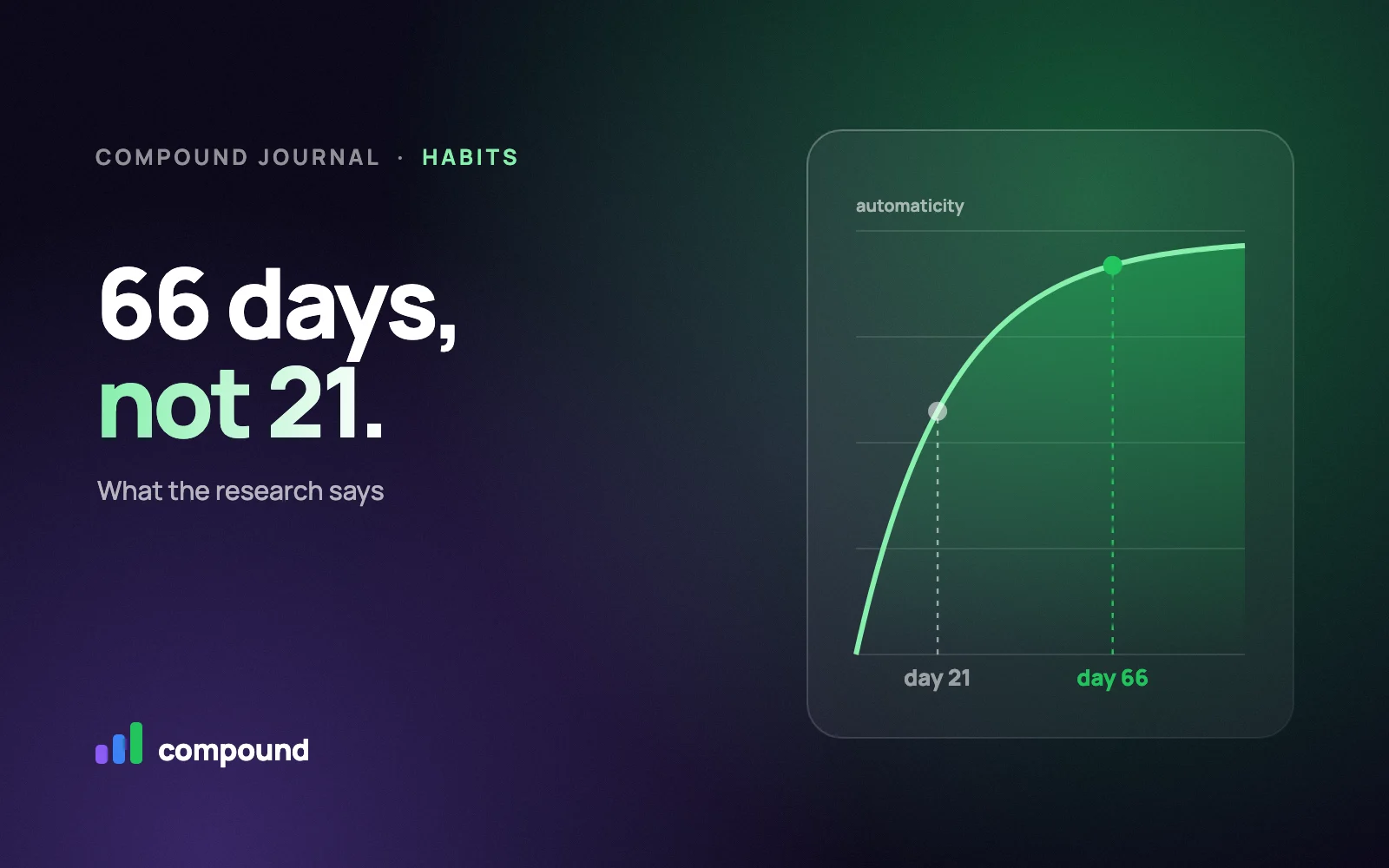
Ask around and you will hear that a habit takes 21 days. It is a tidy number, and it is wrong for most people. The better answer is “longer than you think, and it depends on the habit”, which is less catchy but far more useful once you know the details.
Where “21 days” came from
The figure traces back to the 1960 self-help book Psycho-Cybernetics by plastic surgeon Maxwell Maltz, who observed that patients took “a minimum of about 21 days” to adjust to a changed appearance. Over decades, “a minimum of about” was dropped, and an anecdote about self-image became a rule about habits.
The 66-day study
In 2009, Phillippa Lally and colleagues at University College London followed 96 volunteers who each picked one new daily behaviour, such as drinking water with lunch or doing 50 sit-ups after morning coffee. Participants logged every day whether they had done it and how automatic it felt.
On average, it took 66 days for a behaviour to become automatic. The range ran from 18 to 254 days.
Simple behaviours like a glass of water became automatic quickly. Effortful ones, like exercise, took much longer. The curve was steep at first and then flattened: most of the gain in automaticity arrived early, and the last stretch was slow.
Missing a day doesn’t reset you
One finding matters more than the average: missing a single day did not meaningfully affect the habit-forming process. What hurts is a run of misses, when the cue stops producing the behaviour at all. A practical rule many people use is simple: never miss twice.
Plan for the long middle
Motivation is high in week one and the habit is automatic by month three. The weeks in between are where most people quit. Three things help:
- Anchor to a cue. Tie the habit to something you already do: after coffee, before lunch, when you close the laptop.
- Make progress visible. A ticked grid turns an invisible process into something you can see building.
- Review weekly. Look at your completion rate, not your mood that day. Seventy percent consistency is a habit forming.
A simple 66-day plan
Pick one habit. Track it daily for 66 days. Review every Sunday. If you miss, write down why and show up the next day. On day 66, look back at the month grids and decide whether it still needs tracking or has become part of who you are.
Source: Lally, P., van Jaarsveld, C. H. M., Potts, H. W. W., & Wardle, J. (2010). How are habits formed: Modelling habit formation in the real world. European Journal of Social Psychology, 40(6), 998–1009.